One competitor · one report · $149
Find out why customers leave your competitor.
A cited report built from hundreds of reviews, forum threads and pricing pages, showing how many reviews and posts say each thing, when, and where.
- Delivered within 24 hours
- Full refund if it gives you nothing to act on
- No subscription
Real findings from the Intercom sample report
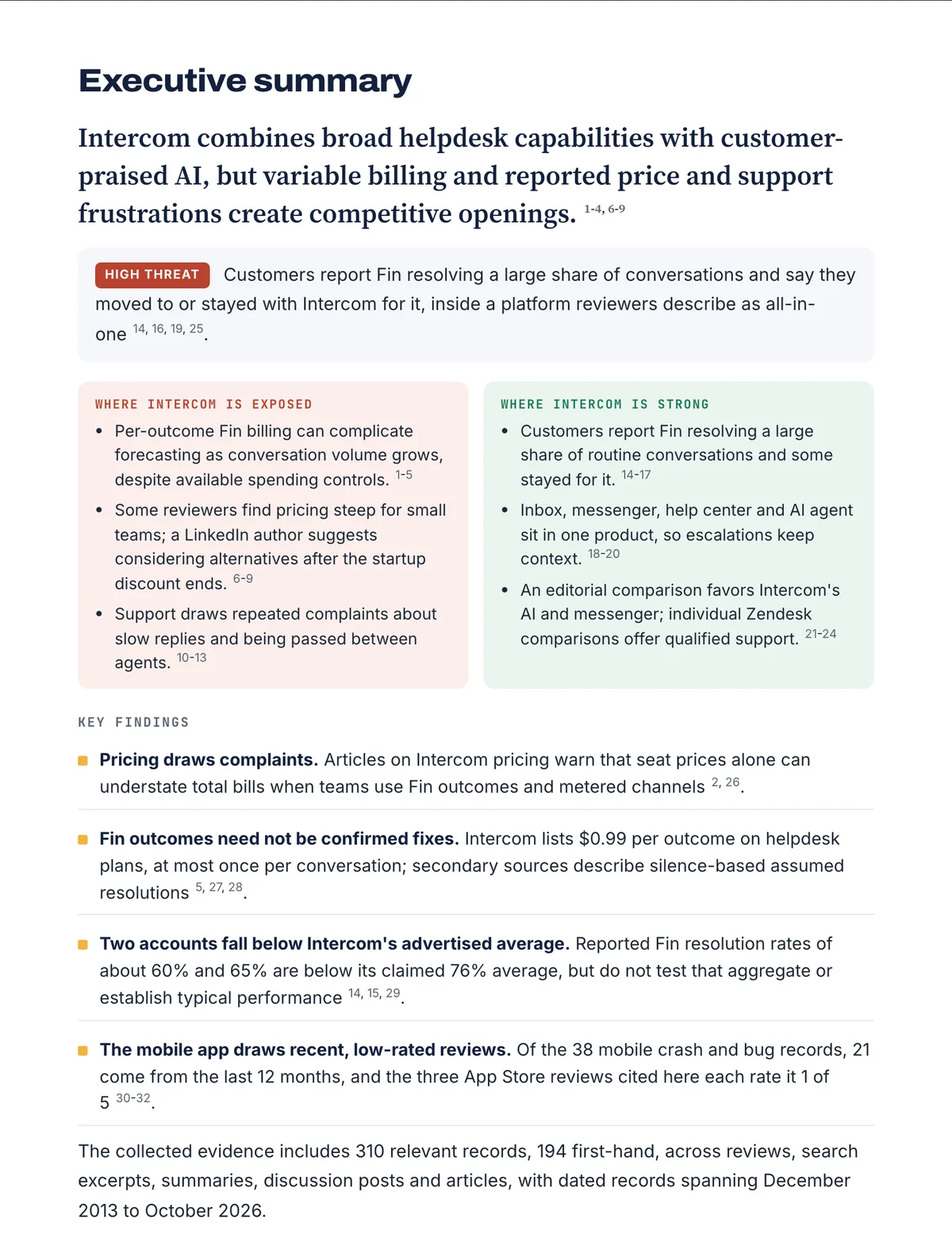
“The price can be a little steep for smaller businesses”
“Not excited about how "soft" resolutions still count as resolutions and are paid for.”
Counted across 310 reviews and posts
Intercom
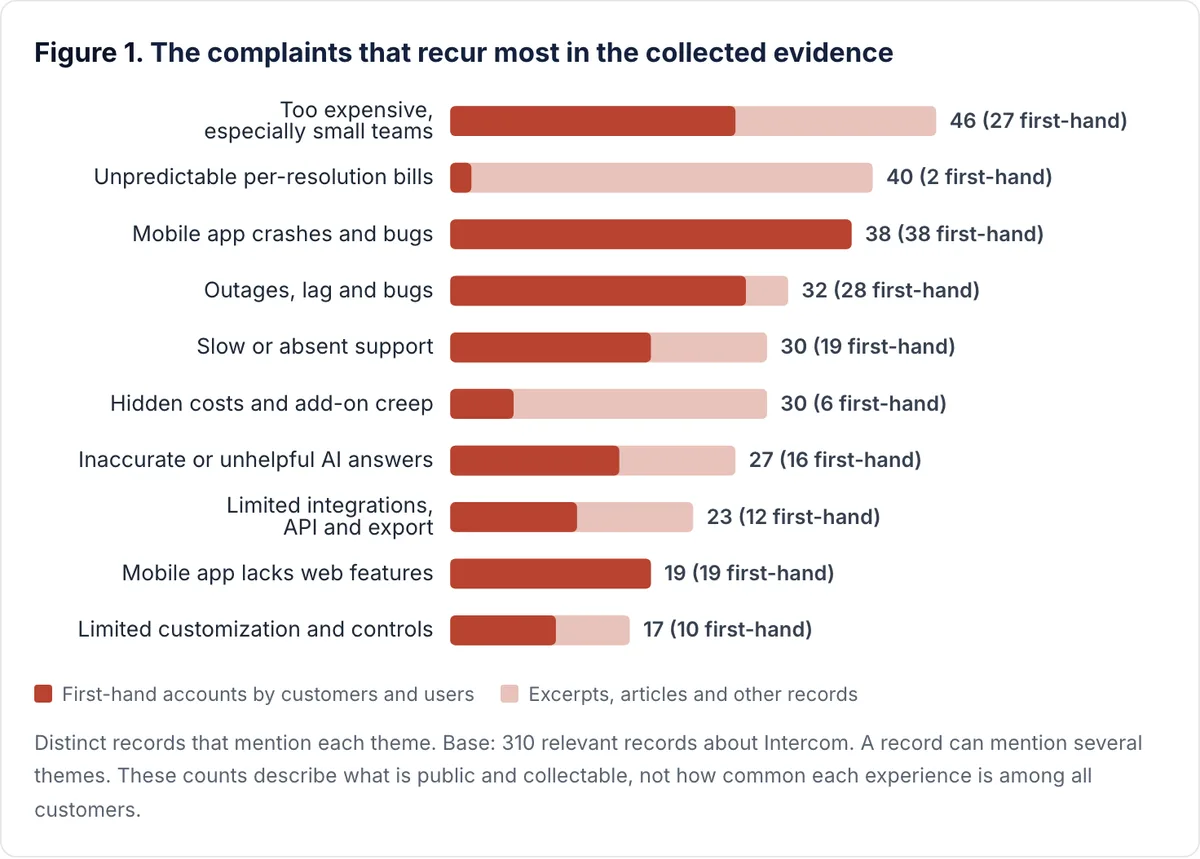
46reviews and posts: too expensive, especially for small teams
- Unpredictable per-resolution bills40
- Mobile app crashes and bugs38
- Praise for the broad all-in-one platform31
What you get
A report you can act on, and check.
A Full report runs 40 to 50 pages. It opens with a one-page verdict, counts every complaint and every reason to stay, and links each claim to the review or post it came from. These pages are from the Intercom sample report.
Know another company better? Read the report on HubSpot or Shopify.
Inside every Full report
What the report helps you decide
Rewrite your positioning, sharpen a battlecard, answer the objection that keeps losing deals, or decide where to price.
01
Executive summary
One page: the verdict, the key findings, and the first three things to do.
02
Who the competitor is
What they sell, to whom, how they charge, and how established they are.
03
Where customers struggle
Recurring complaints, ranked by how many reviews and posts raise them, and how recently.
04
Why customers choose them
The praise you are up against, so you know what not to attack.
05
Product and pricing
Plans, price changes over time, and where buyers feel the price.
06
Positioning and messaging
What they claim, and where their customers say otherwise.
07
Head-to-head
Only when you add your website: where you win, where you lose, with evidence for both.
08
Battlecard
Objections you will hear in deals, and answers backed by their own customers.
09
Recommended actions
Three to five actions ranked by impact, each with an owner, a deadline and a way to tell it worked.
10
What to watch
Their likely next moves, the signal that would confirm each one, and what to do if it happens.
11
What this evidence does not establish
The limits, stated plainly, so you never overclaim.
Why not just ask an AI assistant?
A confident paragraph is not evidence.
A general assistant sounds sure of itself, but you cannot tell which parts are true, which come from one angry review, and which are three years old. Positioning built on that rests on claims nobody has checked.
A typical general answer
Some users find Intercom expensive, particularly smaller teams, and a few mention slower support. Overall it is a strong platform with a well-regarded AI agent.
- How many say it?
- When?
- Where?
The same finding in a Fieldread report
46reviews and posts say Intercom is too expensive, especially for small teams
- 27 of them first-hand accounts
- Each one linked to its source
- Dated, December 2013 to October 2026
- Checked by a second AI model
- Every claim
- Stated confidently
- Counted: how many reviews and posts say it, and when
- Sources
- A few links, often to listicles
- Hundreds of reviews and discussions, each linked
- One-off complaints
- Mixed in with real patterns
- Separated from recurring patterns
- Checking
- None
- Every sentence rechecked by a model from a different AI company
- Limits
- Rarely stated
- A closing section on what the evidence does not show
How it works
Three steps. You only do the first.
- 1
Name the competitor
Paste their website, and yours if you want a head-to-head. We check how much public evidence exists before you pay.
- 2
We read what their customers say
Reviews, forum threads, articles, their pricing history, job posts and docs. Usually several hundred reviews and posts per competitor.
- 3
You get the report
Within 24 hours, usually the same day: a private web page and a PDF you can forward to your team.
Where the evidence comes from
- G2
- Capterra
- TrustRadius
- Trustpilot
- Product Hunt
- Hacker News
- Stack Exchange
- App Store
- GetApp
Plus industry articles, and the competitor's own pricing page (then and now), docs, changelog, job posts and status page. Public pages only: we never log in, never use anyone's account, and quote customers in short excerpts with a link to the original.
Pricing
Paid once. No subscription.
$149per report
Competitors with few public reviews get a shorter report for $49. You see which before you pay.
- One competitor, hundreds of reviews and discussions read
- A head-to-head with your product, when you add your website
- A private web page and a PDF for your team
- Delivered within 24 hours, usually the same day
- Full refund if it gives you nothing you would act on
- No subscription, no account
What exactly do I get?
Where does the evidence come from?
How is this different from asking ChatGPT?
What if my competitor has few reviews?
How long does it take?
Who can see my report?
What if the report is not useful?
Is this a subscription?
I run an agency. Can I order several?
Get the report on your competitor
$149 once. Delivered within 24 hours, with a full refund if it gives you nothing to act on.